

Description
Advanced Alloy Identification & Scrap Metal Sorting with Light-Element Analysis
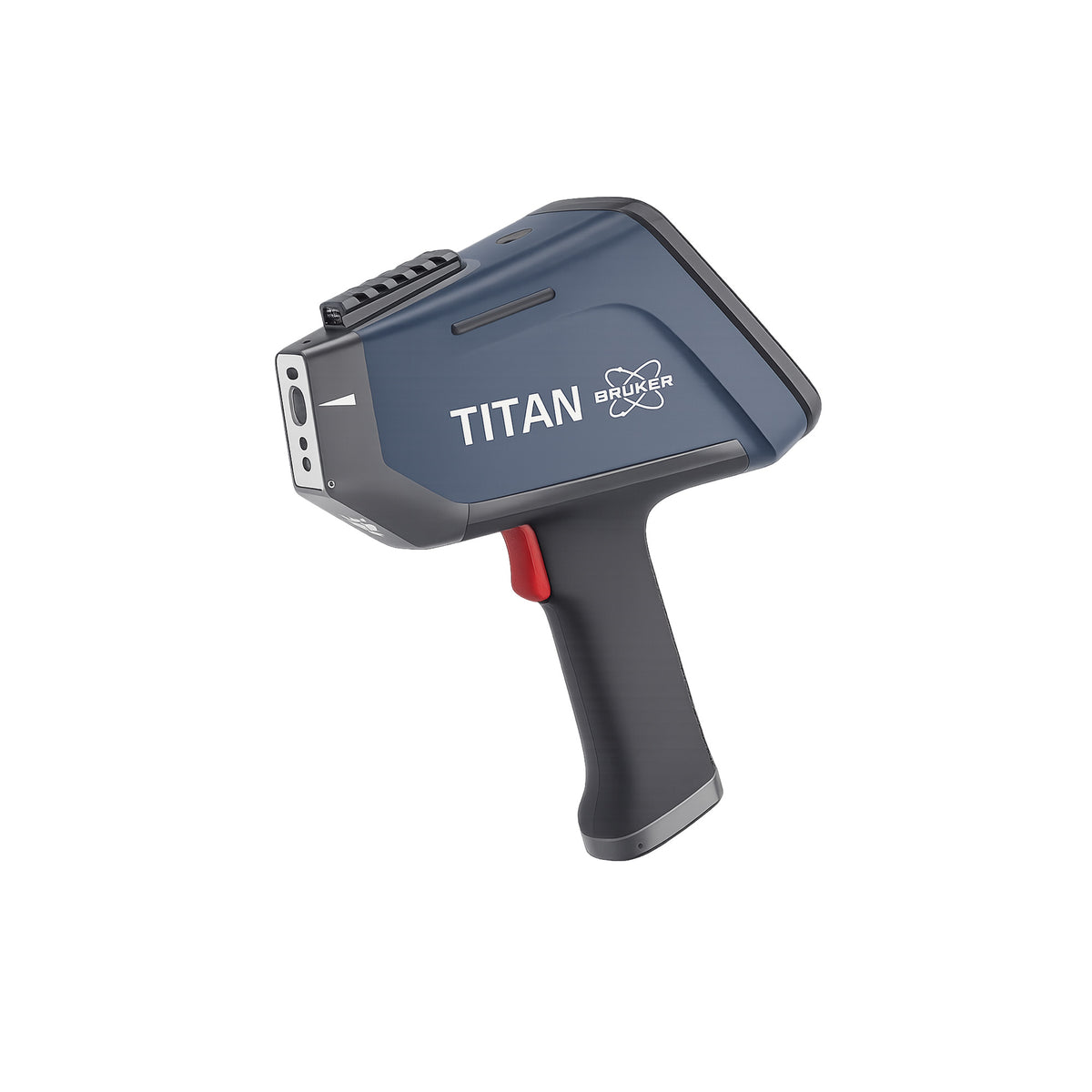
The Bruker TITAN 360 Handheld XRF Analyzer – Alloy is configured for fast, nondestructive alloy identification, scrap metal sorting, incoming material inspection, and Positive Material Identification (PMI).
With the ability to measure important light elements including aluminum (Al), magnesium (Mg), silicon (Si), phosphorus (P), and sulfur (S), the TITAN 360 expands alloy identification into applications where light-element chemistry is critical to reliable grade identification.
For scrap processors, metal recyclers, alloy suppliers, manufacturers, and inspection professionals, the TITAN 360 provides rapid elemental chemistry and alloy identification directly at the point of inspection.
Built for Alloy Sorting
The TITAN 360 is designed to quickly identify and separate ferrous and nonferrous alloys.
Point the analyzer at the material, initiate the test, and use the resulting elemental chemistry and grade identification to make sorting, purchasing, receiving, or material verification decisions.
Common applications include:
- Scrap metal sorting
- Aluminum alloy sorting
- Magnesium alloy identification
- Stainless steel identification
- Low-alloy and tool steel sorting
- Nickel and cobalt alloy identification
- Copper, brass, and bronze sorting
- Titanium alloy identification
- Positive Material Identification (PMI)
- Incoming material inspection
- Metal purchasing and receiving
- Manufacturing and quality control
Light-Element Analysis: Al, Mg, Si, P & S
One of the biggest advantages of the TITAN 360 is its ability to measure the five common light elements encountered in metals analysis: aluminum (Al), magnesium (Mg), silicon (Si), phosphorus (P), and sulfur (S).
Direct measurement of these elements expands the range of alloys that can be identified and differentiated with handheld XRF.
Aluminum (Al)
Important for aluminum-base materials and alloys containing aluminum as an intentional alloying element.
Magnesium (Mg)
Critical for differentiating many aluminum and magnesium alloys where Mg content is an important part of the grade chemistry.
Silicon (Si)
Important for aluminum alloy sorting and other materials where silicon concentration helps distinguish between grades.
Phosphorus (P)
Useful for identifying and differentiating alloys where phosphorus is an important compositional or grade requirement.
Sulfur (S)
Provides additional capability for applications where sulfur content is important to alloy identification, including certain steel grades.
Combined with heavier alloying elements such as Cr, Mn, Fe, Ni, Cu, Zn, Mo, and others, light-element measurement makes the TITAN 360 a powerful tool for demanding alloy sorting applications.
Advanced Aluminum Alloy Sorting
Aluminum is one of the applications where light-element measurement makes a major difference.
Many common aluminum grades depend on magnesium and silicon, in addition to heavier elements such as copper, manganese, and zinc, for reliable differentiation.
The TITAN 360's ability to directly measure Al, Mg, and Si provides substantially more useful chemistry for sorting mixed aluminum than an XRF analyzer limited to heavier elements.
This makes the TITAN 360 particularly well suited for:
- Fine Aluminum sorting in scrap yards
- Secondary aluminum processors
- Metal recycling facilities
- Aluminum distributors
- Foundries
- Manufacturing facilities
- Incoming material inspection
- Aluminum inventory identification
For operations processing significant quantities of aluminum scrap, this capability can help separate material into more useful alloy groups and identify higher-value grades.
Ferrous & Nonferrous Scrap Sorting
The TITAN 360 isn't just an aluminum analyzer.
It provides a single handheld XRF platform for sorting a broad range of ferrous and nonferrous materials encountered in recycling operations.
Stainless Steels
Identify and separate common stainless steel grades using Cr, Ni, Mo, Mn, and other measurable chemistry.
Low-Alloy & Tool Steels
Identify alloy steels using elements such as Cr, Mo, Ni, V, Mn, and other grade-specific chemistry.
Nickel & Cobalt Alloys
Identify valuable high-temperature, corrosion-resistant, and specialty alloys.
Copper Alloys
Sort brass, bronze, copper-nickel, and other copper-base materials.
Aluminum & Magnesium Alloys
Use direct light-element measurement alongside heavier alloying elements for more advanced light-alloy identification.
Titanium Alloys
Identify titanium-base materials and their measurable alloying chemistry.
Turn Unknown Metal into Useful Information
Two pieces of metal can look virtually identical while having very different compositions—and very different values.
Handheld XRF gives the operator elemental information while the material is still in front of them.
For scrap processors, that means the TITAN 360 can become part of the normal sorting workflow:
Test the material → identify the alloy → separate the grade → route the material appropriately.
Bruker specifically positions the TITAN platform for ferrous and nonferrous scrap sorting, with alloy-specific workflows designed for rapid grade identification.
Positive Material Identification (PMI)
The same alloy-analysis capabilities used in scrap sorting can also be used for Positive Material Identification and material verification.
Manufacturers, fabricators, metal distributors, and inspection companies can use the TITAN 360 to verify metallic materials without destroying the component.
Common PMI applications include:
Incoming Inspection
Verify raw materials before they enter inventory or production.
Inventory Identification
Identify unmarked or questionable pipe, plate, bar, fittings, components, and other metallic inventory.
Material Verification
Confirm that installed or supplied materials are consistent with the expected alloy.
Manufacturing Quality Control
Use elemental chemistry and grade identification as part of material-control procedures.
Shipping & Receiving
Check materials during receiving or before shipment.
Fast, Nondestructive XRF Analysis
Handheld XRF provides elemental analysis without cutting or consuming the sample.
Simply position the analyzer against the material and initiate the measurement.
Results are available directly at the point of inspection, allowing the operator to make decisions without routinely sending samples to an outside laboratory.
This is particularly valuable for high-volume sorting operations where hundreds or thousands of pieces of material may need to be evaluated.
Designed for Industrial Use
The TITAN platform is engineered for demanding industrial environments.
Bruker's current TITAN design combines a rugged, IP-rated housing with an intuitive touchscreen interface and advanced graphene-window SDD technology. Bruker's patented DetectorShield™ provides additional protection against detector puncture during field use.
For scrap yards and industrial facilities, these features help make the analyzer practical for everyday use rather than restricting XRF analysis to a laboratory environment.
Software, Results & Reporting
The TITAN platform provides more than a simple grade identification.
Depending on the measurement workflow, operators can work with alloy identification, elemental chemistry, sorting decisions, and analytical results that can be stored for documentation and reporting.
This allows the TITAN 360 to support both rapid scrap sorting and more controlled material-verification programs where analytical records need to be retained.
Optional Test Stands for Closed-Beam Operation
The Bruker TITAN 360 can be paired with optional test stands for closed-beam XRF operation, providing a convenient setup for smaller samples and applications where longer measurement times are desired.
Portable Test Stand
The portable TITAN test stand provides a compact closed-beam setup that can be transported along with the analyzer.
It is particularly useful when analyzing small metal samples, certified reference materials, turnings, small components, and other materials that may be difficult to position reliably for handheld analysis.
The enclosed configuration also makes it practical to use longer measurement times when additional measurement data are desired.
Larger Desktop Test Stand – Coming Soon
For customers performing more frequent benchtop analysis, Alloy Geek will also offer a larger desktop test stand for the TITAN platform.
The larger stand provides a more spacious closed-beam testing area for small samples and routine benchtop XRF analysis while allowing longer measurements without continuously positioning the analyzer by hand.
Contact Alloy Geek for TITAN test stand options and availability.
TITAN 350 vs. TITAN 360
Choosing between the TITAN 350 and TITAN 360 largely depends on the elements and alloy families you need to analyze.
The TITAN 350 is designed for heavier-element analysis, with an elemental range beginning at titanium (Ti). It is well suited for many stainless steels, nickel alloys, cobalt alloys, copper alloys, and other applications where light-element measurement is not required.
The TITAN 360 adds light-element capability, including measurement of aluminum (Al), magnesium (Mg), silicon (Si), phosphorus (P), and sulfur (S). This expands its capabilities for aluminum and magnesium alloy sorting as well as other alloy applications where P, S, Si, or other light elements are important to grade identification.
Don't need light-element measurement?
Explore the Bruker TITAN 350.
Need Al, Mg, Si, P, and S for more advanced alloy identification?
Explore the Bruker TITAN 360.
Why Buy the Bruker TITAN 360 from Alloy Geek?
Choosing a handheld XRF analyzer isn't simply about choosing a model. The application and configuration matter.
Alloy Geek specializes in handheld XRF analyzers, operator training, certified reference materials, accessories, replacement parts, and application support.
Before ordering, tell us what you're trying to sort or identify. We can help determine whether the Bruker TITAN 360 Alloy configuration is appropriate for your materials and analytical requirements.
Have samples you're concerned about? Contact Alloy Geek to discuss your application.