

Description
Advanced Handheld XRF for Mineral Exploration, Mining & Geochemical Analysis
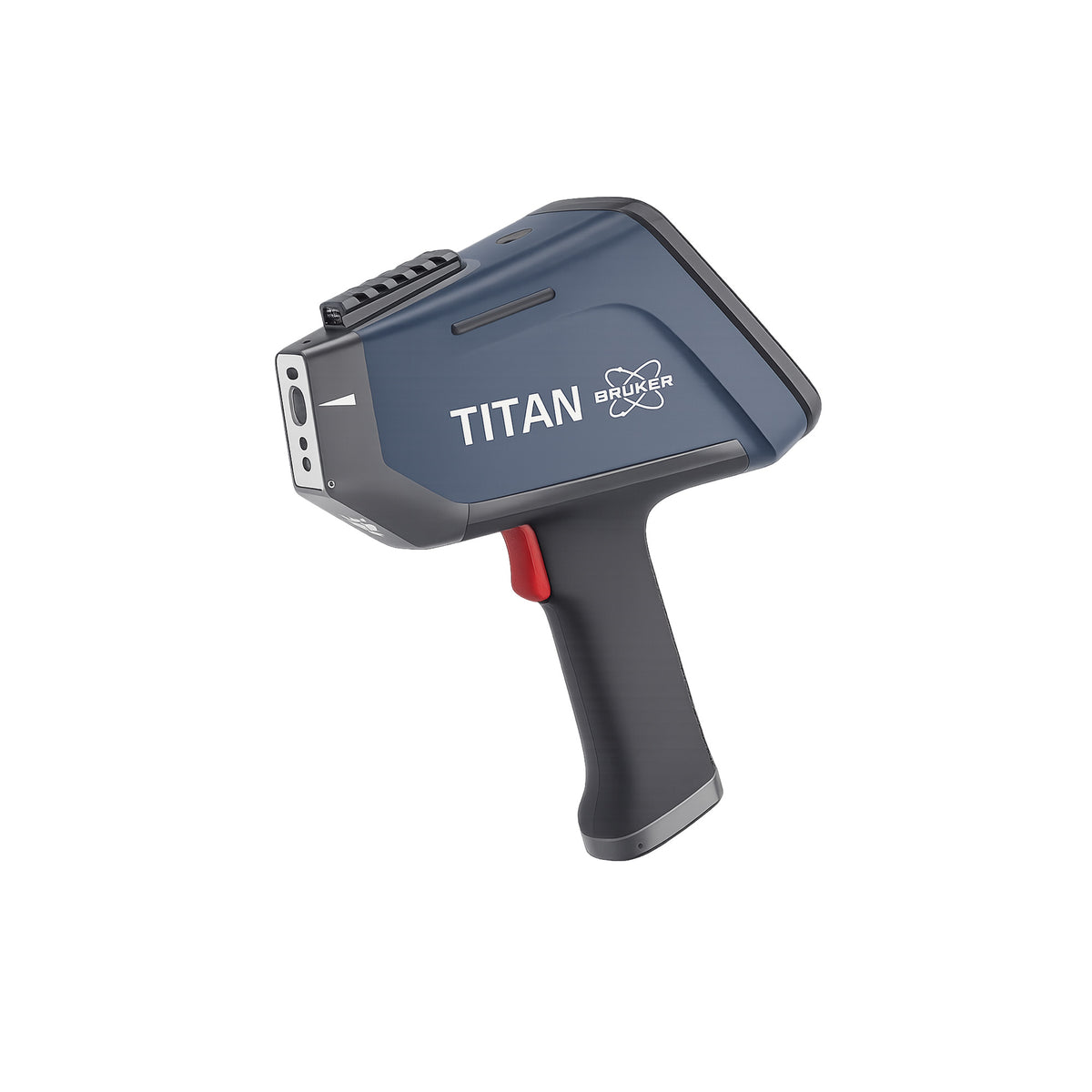
The Bruker TITAN 380 GeoChem Handheld XRF Analyzer is configured for geologists, mining companies, exploration teams, laboratories, and mineral processors that need rapid elemental analysis of geological materials in the field or laboratory.
This configuration combines the TITAN 380's 50 kV, 5 W rhodium X-ray tube, large-area silicon drift detector (SDD), graphene detector window, automatic filter changer, and variable collimation with Bruker's dedicated GeoChemistry Application Package. The TITAN 380 instrument is capable of detecting elements from magnesium (Mg) through uranium (U).
Bruker's GeoChemistry calibration goes beyond simple elemental screening by providing dedicated analytical methods for oxide and sulfide geological matrices, making the TITAN 380 suitable for applications throughout mineral exploration, mining, and ore processing.
Click here to view the Bruker Titan 380 Brochure.
Built for Geochemistry
The TITAN 380 GeoChem provides elemental chemistry directly at the point of analysis, allowing users to rapidly characterize geological materials without waiting for every sample to be sent to a laboratory.
Common applications include:
- Mineral exploration
- Geochemical exploration
- Rock and soil analysis
- Ore characterization
- Mining and grade-control support
- Drill core and rock-chip screening
- Outcrop analysis
- Geochemical anomaly identification
- Pathfinder element screening
- Base-metal exploration
- Precious-metal exploration
- Sulfide mineralization analysis
- Ore processing and material characterization
- Laboratory screening of prepared geological samples
Handheld XRF can be used to rapidly screen large numbers of samples, identify geochemical trends, and help determine which samples warrant additional laboratory analysis.
Bruker GeoChemistry Application Package
This TITAN 380 configuration includes Bruker's dedicated GeoChemistry Application Package, developed for mineral exploration, mining, and ore processing.
Rather than treating every geological sample as the same matrix, the package provides automated and user-selectable calibrations for oxide and sulfide matrices.
Bruker's published GeoChemistry Precision application was developed using 97 reference materials specifically for geological analysis.
This provides an analytical platform designed specifically around the chemistry encountered in geological materials.
Broad Elemental Coverage for Geochemistry
Geochemical analysis requires much more than measuring a handful of metals.
The TITAN 380 GeoChem combines light-element capability with analysis of transition metals, base metals, precious metals, pathfinder elements, and heavier elements.
Bruker's published Oxide 3-Phase calibration includes: Na₂O, MgO, Al₂O₃, SiO₂, P, S, Cl, K₂O, Ca, Ti, V, Cr, Mn, Fe, Co, Ni, Cu, Zn, Ga, As, Se, Rb, Sr, Y, Zr, Nb, Mo, Rh, Pd, Ag, Cd, Sn, Sb, Ba, La, Ce, Hf, Ta, W, Pt, Au, Hg, Tl, Pb, Bi, Th, U
This broad analytical range allows users to examine both the major chemistry of the geological matrix and the minor or trace elements that may be associated with mineralization.
Light Elements & Major Geological Components
One of the major advantages of the TITAN 380 for geochemistry is its ability to analyze light elements important to geological characterization.
The GeoChemistry calibration includes major geological components such as:
Magnesium (Mg)
Important in mafic and ultramafic rocks, magnesium-bearing minerals, alteration systems, and many ore environments.
Aluminum (Al)
A major constituent of many silicate minerals and useful for understanding host-rock and alteration chemistry.
Silicon (Si)
One of the dominant components of most geological materials and an important part of silicate and silica-rich systems.
Phosphorus (P)
Relevant to phosphate minerals and a variety of geological and ore systems.
Sulfur (S)
Particularly important for recognizing and characterizing sulfide-rich materials.
The calibration also includes other important geological components such as potassium (K), calcium (Ca), titanium (Ti), manganese (Mn), and iron (Fe).
This makes the TITAN 380 useful not only for finding target metals, but also for understanding the chemistry of the material surrounding them.
Calcium Analysis
Calcium is included in the TITAN 380 GeoChem calibration.
This can be particularly useful when working with carbonate-bearing rocks, calcium-rich minerals, alteration systems, and other geological materials where Ca chemistry contributes to interpretation of the sample.
In Bruker's published Oxide 3-Phase method, the calibration range for Ca extends from 0–31.14%. Under Bruker's documented test conditions, the published Ca LOD is 9 ppm in pure SiO₂. Actual detection limits depend on sample matrix, interferences, testing time, sample preparation, and other analytical conditions.
Oxide 3-Phase Analysis
The Oxide 3-Phase method is designed for geological matrices where silicates, oxides, and related materials dominate.
It covers major geological components including: Na₂O, MgO, Al₂O₃, SiO₂, P, S, Cl, K₂O, Ca, Ti, V, Cr, Mn, Fe
as well as a broad range of base metals, transition metals, pathfinder elements, precious metals, and heavier elements.
This makes the method useful for general geological characterization, mineral exploration, rock analysis, and geochemical screening.
Sulfide 3-Phase Analysis
Mineralized sulfide materials present a substantially different analytical matrix than ordinary silicate rocks.
For these applications, Bruker provides a dedicated Sulfide 3-Phase method.
The published method includes: MgO, Al₂O₃, SiO₂, P, S, K₂O, Ca, Ti, V, Cr, Mn, Fe
along with important exploration and ore elements including: Co, Ni, Cu, Zn, Ga, As, Se, Rb, Sr, Y, Zr, Mo, Rh, Pd, Ag, Cd, In, Sn, Sb, Te, Ba, W, Pt, Au, Hg, Pb, Bi, Th, U
This dedicated method makes the TITAN 380 particularly useful when investigating sulfide mineralization and base-metal ore systems.
Major, Minor & Pathfinder Element Analysis
Mineral exploration often depends on recognizing elemental associations rather than simply detecting the primary commodity being explored.
Depending on the selected method and sample matrix, the TITAN 380 GeoChem provides access to important exploration elements including: Ca, Ti, V, Cr, Mn, Fe, Co, Ni, Cu, Zn, Ga, As, Se, Rb, Sr, Y, Zr, Nb, Mo, Ag, Sn, Sb, Ba, La, Ce, W, Au, Hg, Pb, Bi, Th, U
These measurements can help geologists investigate lithology, alteration, mineralization, geochemical anomalies, and elemental associations while working in the field.
Precious & Base Metal Exploration
The TITAN 380 GeoChem can be particularly valuable in exploration programs targeting base and precious metals.
Elements available within the geological calibrations include important commodities and associated elements such as:
Copper (Cu), Nickel (Ni), Cobalt (Co), Zinc (Zn), Lead (Pb), Silver (Ag), Gold (Au), Platinum (Pt), Palladium (Pd)
along with potential pathfinder and associated elements such as As, Sb, Se, Mo, W, Bi and Hg.
XRF results should be interpreted within the limitations of the technique, particularly when working at low concentrations or with heterogeneous geological samples. Laboratory analysis may still be required for definitive assay or regulatory reporting.
Three-Phase GeoChemistry Analysis
Bruker's published GeoChemistry Precision method uses three analytical phases to optimize excitation across different portions of the elemental spectrum.
The published 8 mm GeoChemistry Precision method uses:
Phase 1 – 30 kV
Phase 2 – 50 kV
Phase 3 – 15 kV
with a published measurement time of 60 seconds per phase.
Longer analysis times can improve detection limits for many elements. Bruker notes that individual elemental detection limits improve as a function of the square root of analysis time, while actual performance also depends on matrix effects, spectral interferences, statistical confidence, and testing conditions.
Small & Large Spot Analysis
The Bruker TITAN 380 features an automatic variable collimator with both small and large spot analysis, providing flexibility for geological samples with different sizes, features, and levels of heterogeneity.
The small spot can be useful for targeting specific areas of interest such as mineralized veins, inclusions, and other localized geological features.
The large spot analyzes a broader area of the sample and is useful when a larger measurement area is preferred.
This flexibility allows operators to select the measurement spot that best fits the sample and analytical objective.
Field Analysis or Prepared Samples
The TITAN 380 can be used directly on geological materials in the field or with prepared samples when improved repeatability and representativeness are required.
Field applications may include direct analysis of: Outcrops, drill core, rock chips, soil, ore, mine faces, stockpiles, concentrates, processed material
For more controlled analysis of powders, Bruker's GeoChemistry Precision application recommends that samples be firmly packed in a sample cup using 4 µm Prolene film.
Grinding, homogenization, and consistent sample preparation can substantially improve the representativeness and repeatability of XRF measurements on heterogeneous geological materials.
Designed for Field Use
The TITAN 380 combines advanced analytical capability with a handheld platform designed for industrial and field environments.
Key instrument features include:
- 50 kV, 5 W rhodium (Rh) X-ray tube
- 5–50 kV X-ray generator
- Large-area silicon drift detector (SDD)
- Graphene detector window
- TITAN Detector Shield
- Mg–U instrument detection capability
- Automatic 5-position primary beam filter changer
- Automatic variable collimator
- Small and large spot analysis
- SharpBeam optical beam path
- IP64-rated industrial housing
- No-slip rubberized grip
- Dual cameras for site viewing and aiming
- Integrated GPS
- Wi-Fi, Bluetooth, USB and iSD connectivity
- 32 GB iSD storage
- Hot-swap battery capability
- In-device battery charging
- TITAN OS multilingual interface
Software & Reporting
The TITAN 380 includes Bruker software capabilities for working with analytical results and instrument data.
The supplied software package includes functionality for: Reporting, qualitative spectral analysis, flexible data handling, user field editing, remote instrument control
Combined with onboard data storage and multiple connectivity options, the TITAN 380 can support field data collection as well as subsequent reporting and review.
What's Included
The Bruker TITAN 380 GeoChem configuration from Alloy Geek includes:
- Bruker TITAN 380 Handheld XRF Analyzer
- Bruker GeoChemistry Application Package
- Automated and user-selectable oxide and sulfide calibrations
- Powdered GeoChem check sample
- Two high-performance Li-ion batteries
- Smart battery charger
- 32 GB iSD card
- 10 spare Prolene protective windows
- Waterproof, pressure-equilibrated transport case
- Bruker software package
- 1-Year Standard Warranty
The GeoChemistry package supplied in the Bruker quote specifically includes a powdered check sample.
Optional Desktop Test Stand
The TITAN 380 can be paired with the optional Bruker TITAN Desktop Stand for closed-beam XRF operation.
A test stand is particularly useful for smaller samples, prepared sample cups, reference materials, and applications requiring longer measurement times.
This provides a convenient way to transition the TITAN 380 between handheld field analysis and more controlled benchtop-style measurements.
Why Choose the TITAN 380 for Geochemistry?
The TITAN 380 GeoChem combines the portability of handheld XRF with an analytical platform specifically configured for geological applications.
Its combination of light-element capability, oxide and sulfide calibrations, three-phase analysis, broad elemental coverage, variable spot sizes, and a 50 kV X-ray source makes it suitable for demanding exploration and mining workflows where understanding the overall chemistry of a geological sample matters.
From Mg, Al, Si, K and Ca through base metals, precious metals, pathfinder elements, Th and U, the TITAN 380 gives geologists a powerful tool for rapidly investigating geological materials directly where the work is being performed.